Taylor's Secret: Merge Story
- 4.6
- Rating
- 1.00M
- Installs
- Free
- Price

 Analysis by App-foxy
I went into Taylor's Secret: Merge Story expecting a light puzzle game, and that is exactly where it feels most comfortable. Its central appeal is the simple pleasure of combining matching objects and watching a small piece of progress appear on the board. The adventure framing gives those actions a reason to continue, while the merge mechanic keeps each move easy to understand. I would recommend it to someone who enjoys relaxed mobile puzzles with a story-shaped sense of movement rather than intense competition or complicated controls.
The game is free to download, carries an Everyone age rating, and comes from Merge story. It has already passed one million installs, with an average rating of 4.6 from roughly twenty-eight thousand ratings. Those numbers suggest that the basic formula has found a broad audience, but they do not remove the need to look at how it actually feels during ordinary play. For me, the important question is not whether the first merge is satisfying; it is whether the game gives me a good reason to make the next one without turning every pause into pressure.
How the merge loop feels from the first move onward
I like that the first move is easy to grasp, but the more useful question is what each merge leaves available afterward. I’d treat the board as a small space-management puzzle: look for a combination that advances a goal while preserving room and options, rather than merging simply because a pair is ready. That deliberate rhythm is what sets up the next part of the experience.
You May Also Like

 Blood Strike: 2.5 Anniversary
Blood Strike’s Loadouts Turn Every Drop Into a Tactical Gamble
A close look at Blood Strike’s custom loadouts: how fast access to signature weapons reshapes its battle royale rhythm, rewards preparation, and narrows the gap between fights.

 Pandora - Music & Podcasts
Pandora’s Music Is Easy to Start, but Harder to Recover
Pandora’s strength is its low-effort path from a seed to a station. Its weak spot is how much confidence it asks you to place in connection, setup, and quiet recovery.

 8 Ball Pool
 Is Built on Rivalries, Rematches, and Routine
A close look at the rivalries, rematches, shared routines, and unanswered safety questions that turn a quick pool match into a persistent mobile community.

 Samsung Music
’s Quiet Strength Is Playing What You Already Own
Its reach comes less from spectacle than from dependable access to a personal library. That simplicity is both the app’s strongest retention engine and its ceiling.

 AccuWeather: Weather Radar
AccuWeather Review: A Quick, Clear Forecast for Everyday Decisions
For everyday plans, the best forecast is the one you can understand quickly. AccuWeather makes rain timing, radar, and local conditions easy to act on, with a few trade-offs.

 Hill Climb Racing
Why Hill Climb Racing Still Turns Crashes Into One More Run
A tiny car, a bumpy hill and one more upgrade: Hill Climb Racing keeps resurfacing because its simple chaos makes every near-miss feel personal.
More From Our News Desk
View All News


The first action is deliberately simple
The opening interaction is the kind of action I can understand immediately: identify compatible pieces, bring them together, and see the board change. That directness matters on a phone. I do not need to learn a large control scheme before making progress, and the puzzle category remains clear even when the adventure presentation adds context around it.
What I like about this starting point is that the move has a visible consequence. A merge does not feel like tapping through a menu or completing an abstract calculation. The board gives me a small before-and-after moment, and that is enough to make the next available combination noticeable. The game works best when I approach it as a chain of modest decisions rather than as a single difficult puzzle to solve perfectly.
That also makes it suitable for players who are new to merge games. Someone who normally avoids traditional match-three puzzles may find this structure less hurried because the focus is on building and combining rather than racing against a timer. At the same time, experienced merge players will recognize the familiar need to look ahead instead of spending every useful object immediately.
Why the feedback rhythm keeps me playing
The strongest part of the experience is the rhythm between action and response. I make a merge, the board becomes more organized or more advanced, and a new target appears in my mind. That feedback is small, but it is frequent enough to create momentum. I am rarely wondering whether a move mattered; I can usually see the result right away.
This is where the adventure layer helps. A merge on its own can become repetitive, especially when the board is asking for several similar combinations. Giving those actions a broader sense of discovery makes the repetition easier to accept. I am not only clearing space; I am using the space to move Taylor's situation forward. The story does not need to dominate every moment for that framing to be useful.
My practical advice is to pause after each meaningful combination instead of dragging pieces around automatically. The immediate reward encourages fast play, but a few seconds of observation can reveal a better sequence. If I use the first available merge without considering what it leaves behind, I can create a crowded board and reduce my options. The game is more enjoyable when I treat the board as a small planning problem, not just a string of taps.
That is one of the less obvious strengths of the design: the satisfying part is not only the merge animation or the appearance of a higher-level object. It is the change in future possibilities. A good move can make the next several moves easier, while an impatient move may produce a short reward and a less useful position afterward. Players who enjoy gentle strategy will get more from it than players who only want instant matching.
The reward is progress, not just the move itself
The reward structure feels most effective when a combination solves two problems at once. I get the immediate satisfaction of creating something new, and I also gain a clearer direction for the next objective. That second layer is important because it turns otherwise ordinary item management into a reason to continue.
I found the game particularly comfortable in short sessions. If I have a few spare minutes, I can make several decisions, improve the board, and stop at a natural point. There is no need to reserve a long uninterrupted evening for it. This makes it a good companion for a commute, a waiting room, or a quiet break, provided I am looking for a calm puzzle rather than a high-energy challenge.
There is a trade-off here. The same steady progression that makes the game approachable may feel too gentle for anyone who wants demanding logic puzzles. The challenge comes from arranging and prioritizing merges, not from complex rules or severe time pressure. If your favorite puzzle games are built around one difficult solution with a strong “aha” moment, this may feel more repetitive than rewarding.
I also think the free-to-play structure deserves attention before anyone settles in. The game is free, but in-app purchases range from $0.99 to $99.99 per item. That wide range means I would approach optional spending carefully, especially if I were tempted to buy something simply to remove a moment of waiting or board friction. The sensible way to play is to decide on a personal limit before the loop becomes habitual, rather than treating every convenient purchase as part of normal progress.
What happens when a session resets
The reset point is one of the reasons I can return to the game without feeling that I have to commit to a large block of time. I can finish a small objective, put the phone down, and come back later with a new immediate task in mind. That makes the loop feel less demanding than games that punish a player for leaving halfway through a long run.
Still, a reset is not the same as a complete change of pace. The core action remains merging, so the game depends on whether I enjoy repeating that process. When I am in the mood for orderly progress, the repetition is soothing. When I want a completely different puzzle type, the familiar board can feel like more of the same.
A useful habit is to stop after creating a clear improvement rather than continuing until every possible move is exhausted. Ending on a successful combination gives the next session a clean emotional starting point. It also prevents the common mobile-game problem of turning a relaxing break into an unplanned, extended stretch of play. For me, the best sessions have a beginning, a handful of deliberate merges, and a natural stopping point.
The game is listed with a current version of 1.8.8 and supports devices running Android 8.0 or later. That makes the compatibility requirement worth checking before installation, particularly if you use an older phone or tablet. On a suitable device, the format is well matched to touch controls: the board is the focus, and the interaction does not demand the precision of a fast action game.
Where it fits among other puzzle games
Compared with a standard match-three title, this game feels more like gradual construction than rapid clearing. Match-three games usually ask me to scan for a pattern and make a quick exchange, while a merge game asks me to think about what each object can become and where it should sit. That difference makes Taylor's Secret a better choice for players who like planning space and a slower buildup.
Compared with a purely decorative story game, it gives me more to do with each visit. The narrative setting is not the only reason to open it; the board itself provides a repeatable activity. On the other hand, someone who mainly wants a deep, character-driven adventure may find the puzzle loop more prominent than the story atmosphere.
It also sits apart from competitive puzzle apps. I do not choose it when I want leaderboards, rapid matches, or pressure from another player. I choose it when I want control over the pace and a visible sense of accumulation. That distinction is important, because the app's appeal comes from personal progress rather than proving that I can solve something faster than everyone else.
Small strategies that make the board easier to manage
My first useful strategy is to avoid treating every matching pair as an emergency. If two items can merge, that does not always mean they should merge immediately. Keeping a little flexibility can be more valuable than taking a quick reward, especially when the board is becoming crowded. I look for combinations that both advance an objective and open a useful space.
Second, I try to notice which objects are limiting my next step. Instead of spreading attention evenly across the board, I focus on the item chain that is closest to producing a meaningful result. This reduces aimless movement and makes each session feel more directed. It is a simple change, but it turns the game from passive tidying into a series of small priorities.
Third, I use short visits intentionally. A quick session works well for checking the board, completing one or two useful merges, and leaving before I start making careless decisions. If I keep playing only because the next reward is visible, I am more likely to spend resources or create clutter without a clear plan. The reset is more satisfying when I choose it rather than reach it through frustration.
These habits also clarify who should skip the game. I would not choose it for a child or adult who needs constant novelty, fast reactions, or a difficult brainteaser every few minutes. I would also be cautious recommending it to anyone who dislikes free-to-play purchase prompts in principle, even though the download itself costs nothing. The combination of optional spending and a repeating merge loop may feel too familiar to players who want a fully self-contained premium puzzle.
Who will get the most from Taylor's Secret
I see the best fit as a casual puzzle player who likes visible progress, light adventure context, and sessions that can be stopped and resumed easily. It is also a reasonable choice for someone trying the merge genre for the first time because the basic action is approachable and the board communicates its immediate results clearly.
A realistic everyday example would be using it during a short lunch break. I could open the game, check which combinations are available, make a few moves that improve the board, and stop before the break ends. The attraction is not that it transforms ten minutes into a major achievement. It is that the time has a clear shape: action, feedback, a small reward, and a comfortable reason to return later.
Families may appreciate the Everyone rating, but I would still judge the experience by the individual player. The rating makes the game broadly accessible from an age-classification perspective; it does not mean every player will enjoy the pace or the purchase model. For younger users, I would pay particular attention to how optional purchases are handled on the device.
My final view of the loop
After spending time with it, I think the game succeeds because its loop is easy to enter and easy to understand. I make a combination, receive immediate visual progress, gain a new short-term reason to continue, and can later reset the session without losing the relaxed character of the experience. That sequence is not revolutionary, but it is coherent and pleasant when I want a low-pressure puzzle.
The main limitation is equally clear: the loop can become repetitive if I do not already enjoy merging as a form of play. The adventure framing adds motivation, but it does not replace the board. Players looking for deep story choices, competitive intensity, or unusually complex puzzles should choose a different kind of game. Players who dislike spending prompts should also approach the free download with a firm budget and realistic expectations.
For me, Taylor's Secret: Merge Story is worth trying when I want a calm mobile puzzle with a steady sense of discovery. I would start with the free version, learn how quickly the progression feels comfortable, and use the planning habits above before considering any purchase. The best reason to keep playing is the clean action-to-reward rhythm: each thoughtful merge changes the board enough to make the next session feel inviting, without demanding that every visit become a long commitment.
FAQs for Taylor's Secret: Merge Story
01What is Taylor's Secret: Merge Story about?
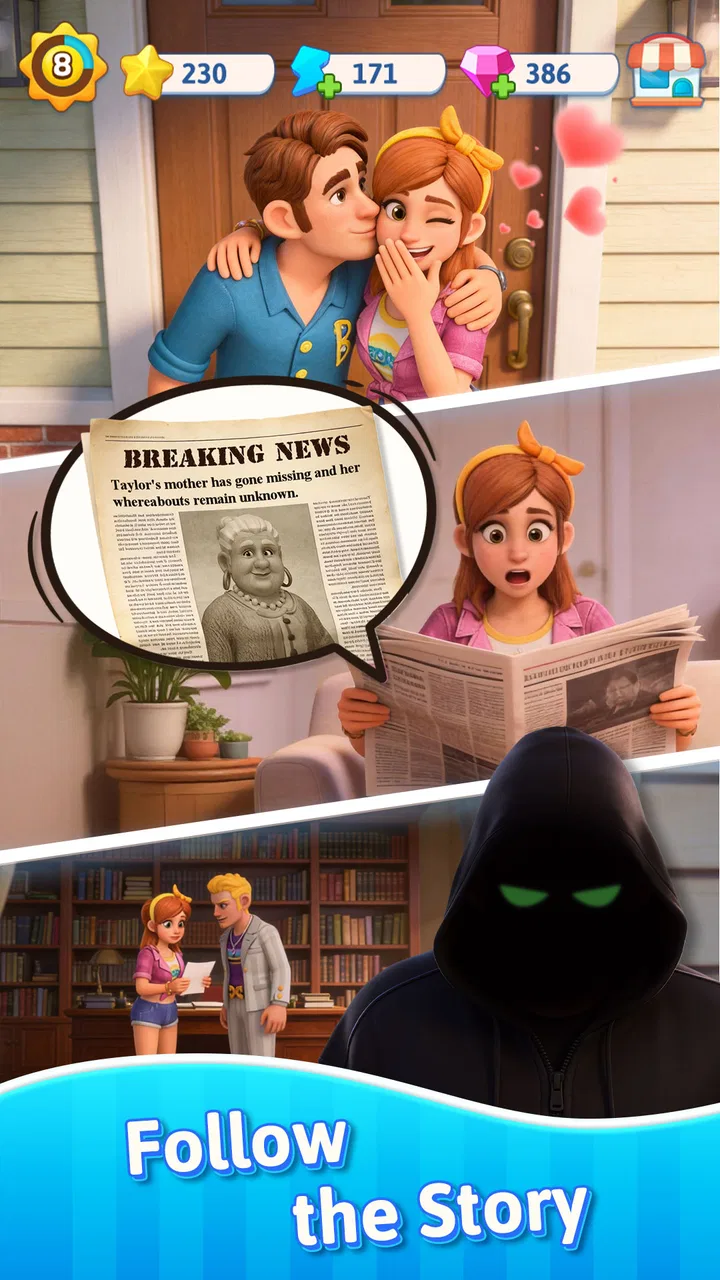
Taylor's Secret: Merge Story is a casual puzzle and story game built around merging objects to complete tasks and unlock new chapters. You help Taylor restore locations, discover clues, and meet characters while progressing through a light mystery narrative. Each successful merge creates a more useful item, so planning your combinations is important when the board becomes crowded.
02How does the merging gameplay work?
The main gameplay is based on combining three or more identical objects to create an upgraded item. These items are then used to fulfill orders, repair areas, and advance Taylor's story. Energy or similar limits may restrict how often you can generate objects, so it is worth saving resources, merging efficiently, and avoiding unnecessary combinations when you are close to completing an important objective.
03Can Taylor's Secret: Merge Story be played offline?
Some basic merging activities may remain available without a stable internet connection, but the complete experience can depend on online services. Story updates, advertisements, cloud synchronization, special events, purchases, and account-related features may require internet access. If you plan to play while traveling, download the game first and test which features work offline on your particular Android or iOS device.
04Does the game include in-app purchases or advertisements?
Taylor's Secret: Merge Story may offer optional in-app purchases and advertising-based rewards, as is common with free-to-download merge games. These can provide extra energy, useful items, or faster progress, but spending is not necessarily required to explore the story. Parents should review the device's purchase controls, and all players should check the current store listing for the latest pricing and monetization details.
05Is Taylor's Secret: Merge Story suitable for all ages?
The game is generally aimed at players who enjoy relaxed puzzles, item management, and casual story-driven gameplay. Its mechanics are easy to understand, although later stages can encourage frequent returns or optional spending. The exact age rating, privacy practices, permissions, and content classification can vary by platform and region, so review the Google Play or App Store information before installing, especially when the game will be used by children.
Pros
- Relaxing merge gameplay that is easy to learn and play casually.
- Story chapters provide extra motivation beyond completing merge tasks.
- Decorating and rebuilding areas gives a satisfying sense of progress.
- Short sessions make it suitable for playing during spare moments.
- Bright visuals and character-focused presentation are appealing to many players.
Cons
- Energy limits can interrupt play when you want to continue a task.
- Some upgrades and story progress may require substantial grinding.
- Frequent rewards can make the interface feel busy at times.
- Later merge goals may become repetitive for players seeking more variety.
- Progress may feel slower without using optional in-app purchases.

Taylor's Secret: Merge Story
Gallery